|
General
Information & Frequently Asked Questions
TOPICS
SCHOOL
ADDRESS
The school´s address
is Barrio Dent, from Autos Subaru, 300 meters North and 50
meters West.
We are located in a very nice up-scale residential/commercial
neighborhood on the East side of San José. CRLA is just 20
minutes walking distance from downtown San José, close to
the well-known San Pedro Mall and to a variety of restaurants,
banks, shops, nightclubs, cinemas, theaters and museums.
MAIL
Students can receive mail here at the school since
our address is more reliable than the host family's. Our mailing/postal
address is:
c/o COSTA RICAN LANGUAGE ACADEMY
P.O. BOX 1966-2050
SAN JOSE, COSTA RICA,
CENTRAL AMERICA
Students can also use our fax number to send ($4) and receive
faxes (Free).
E-MAIL
Students can send and receive e-mail at the school
for free. Each student may  sign
up each day to use our computers. We have several computers
available for students to send e-mail or use the internet.
The address is the same for all students, <[email protected]>,
just include student's name next to the address or in the
subject line. We check e-mail several times a day and print
out all the messages for the students. sign
up each day to use our computers. We have several computers
available for students to send e-mail or use the internet.
The address is the same for all students, <[email protected]>,
just include student's name next to the address or in the
subject line. We check e-mail several times a day and print
out all the messages for the students.
INTERNET
There are several computers connected to the Internet
at all times and are available to students free of charge.
There are also other places in San José (Internet Cafes) where
students have access to the internet if they want to use it
more frequently or for longer time.
TELEPHONE
 Each
homestay family has a telephone which students may use, but
we prefer for students to use the school's telephones instead
of the family's whenever possible. This is because telephone
service is expensive for the families here and there is no
set monthly cost; every minute of use is charged. At the school,
local calls are free and for long distance calls students
can call collect or use a telephone card. Students may also
buy calling cards for international calls at the school. Students
may also receive calls from friends and family at the school. Each
homestay family has a telephone which students may use, but
we prefer for students to use the school's telephones instead
of the family's whenever possible. This is because telephone
service is expensive for the families here and there is no
set monthly cost; every minute of use is charged. At the school,
local calls are free and for long distance calls students
can call collect or use a telephone card. Students may also
buy calling cards for international calls at the school. Students
may also receive calls from friends and family at the school.
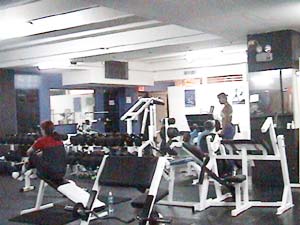
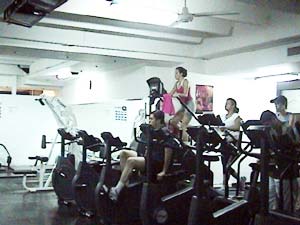
GYM NEAR TO SCHOOL
The San Pedro Mall
Gym, located two blocks away from CRLA, offers our students
a special price of $25/month. Students can use the gym facilities
whenever they want from 6:00 am to 9:00 pm (Monday to Friday),
Saturdays 9:00am to 7:00 pm and Sundays 9:00 am to 3:00 pm.
CLASS SCHEDULE
Classes start at 9:00 am until 12:00 noon. (Morning
classes are usually devoted to grammar, oral exercises, new
vocabulary, reading & discussion of texts, specific questions
from the students and revision of homework and working on problem areas). Then there is a lunch break from
12:00 -1:00 pm Afternoon classes are from 1:00 - 2:00 pm (for
students receiving 4hrs/day), from 1:00-3:00 pm (for students
receiving 5hrs/day). or 1:00-4:00 pm (for students receiving
6hrs/day.) and emphasize conversation and pronunciation.
working on problem areas). Then there is a lunch break from
12:00 -1:00 pm Afternoon classes are from 1:00 - 2:00 pm (for
students receiving 4hrs/day), from 1:00-3:00 pm (for students
receiving 5hrs/day). or 1:00-4:00 pm (for students receiving
6hrs/day.) and emphasize conversation and pronunciation.
After their Spanish classes the students participate in the
afternoon cultural activities:
- Latin dance classes (Everyday from 3:00 -4:00 and 4:00-5:00pm)
- Cooking classes (Wednesdays 4:00-5:00pm)
- Conversation classes (Tuesdays & Thursdays 4:00-5:00pm)
All classes (including culture classes) are conducted completely
in Spanish. Many students have studied Spanish before coming
to the Academy but we believe that this is the ideal setting
to improve their conversation skills and fluency. Therefore,
we have designed our classes to ensure maximum student participation.
Our Homestay program, afternoon conversation classes and the
school's friendly atmosphere also provide additional opportunities
for conversation.
In addition to activities and classes inside the school, during
their free time, students also participate in activities outside
the Academy such as:
- visits to museums and markets located near the Academy
- night outings to local discotheques and dance clubs accompanied
by our dance instructor
- night outings to restaurants, bars and theaters located
near the Academy
- weekend excursions to beaches, rain forests, volcanoes and
National Parks
FIRST DAY OF CLASS
On the first day of class we require students to be
at the school at 8:00 AM so we can give them information,
a student card with telephone number and exact address of
the homestay to give to taxi drivers, and general orientation.
We also make a short evaluation to determine their Spanish level. On the
first day of class the host family will accompany the student
to the Academy. The family will show the student how to get
to the school. (usually a short 10-15 minute bus ride). Students
take the bus about 1 or two blocks away from their homestay
and are dropped off at a bus stop 1 or 2 blocks away from
the school). **
short evaluation to determine their Spanish level. On the
first day of class the host family will accompany the student
to the Academy. The family will show the student how to get
to the school. (usually a short 10-15 minute bus ride). Students
take the bus about 1 or two blocks away from their homestay
and are dropped off at a bus stop 1 or 2 blocks away from
the school). **
Host families will also return to the Academy in the afternoon
and take the student back home after classes on the first
day and until it is necessary and the student knows his/her
way around.
** Public buses are very easy to use, very cheap (about US
20 cents) and they run every 10-15 minutes from 5:30 am until
11:00 pm. If students go out at night we recommend that they
take a taxi back home (taxis are also cheap: about US $3-$6)
ORIENTATION
Since we operate on an open enrollment basis, we have
new students arriving at different times. Each Tuesday, we
have an orientation meeting for the new students.
Each new student, on his/her first day, will also receive
information about the school, the homestay program, etc. The
student will meet with one of our teachers who will show him/her
the school and explain the facilities offered (use of e-mail,
etc). This teacher will make an evaluation to determine the
student's Spanish level and decide what class would be best
for the student.
During his/her stay, the staff at the reception desk can give
the students maps, bus schedules, banking informaiton, tourist
information and will help with any questions the students
may have. Our school is small and we try to have a very open
and warm atmosphere. We like to have close contact with each
student and we do our best to make them feel welcome and at
home.
HOW WE DETERMINE EACH STUDENT'S SPANISH
LEVEL
- Each new student, on his/her first day, will meet
with one of our Spanish teachers for a short oral evaluation.
This, along with the student's background in Spanish (previous
Spanish lessons received, knowledge of other languages, visits
to Spanish-speaking countries, etc.) helps us determine the
student's level and decide what class would be best for the
student. Then, after the first lesson we confirm with each
new student and his/her teacher that the level assigned was
appropriate. If not, we make the necessary changes.
- Since new students arrive each week and everyone learns
at a different pace, we monitor students' progress constantly
and we encourage students to tell us how they feel about their
lessons so we can make changes in the groups if necessary.
CLASSES FOR ABSOLUTE BEGINNERS
Many of the students who come to our school have never
had a Spanish class before, so we do have classes for absolute
beginners. Most families do only speak Spanish, however this
is really no problem for beginner students. The families are
used to having students who don't speak Spanish, and are very
patient in trying to communicate using basic words and sign
language. The staff from the school can also serve as translators
when needed. They speak English and some of our teachers speak
German.
ADVANCED CLASSES
For very advanced students, we offer upper-level classes
such as literature (Latin American or children's literature),
conversation and advanced grammar. We also offer other specialized
classes, such as Business Spanish (finance, medical or legal
terms).
INSTRUCTORS
All our instructors
have university degrees in Spanish Education, Philology, or
Linguistics at the University of Costa Rica or the National
University. Others come from similar fields, such as Journalism.
Most of them have worked at our school for 3 years or more
and all have ample experience teaching Spanish as a second
language. They are all very professional and friendly.
ACCOMMODATIONS IN HOST FAMILY

While a room with a family is not always as luxurious
and comfortable as a hotel room, it is much less expensive
and gives students the opportunity to practice their Spanish
and learn about our culture. Host families provide students
with halfboard (breakfast & dinner) and laundry service. Each
student will have his/her private room.
HOST FAMILY SELECTION
How are families selected for homestays?
The homestay families are carefully selected for their hospitality
and for safe and clean housing. We place students with many
different types of families (with or without children, married
couples, single parents, young or older, etc.) We assign homestay
families according to the preferences the students select
in their registration form. We personally visit and meet with
each family, and we evaluate them on a regular basis by asking
each student to fill out a questionnaire about the family
and their experiences at the home.
EXCURSIONS
As you can see in our price
lists, some of our intensive 4 week programs include
1 or 2 excursions. In addition, each week we help students
with their travel plans for the weekends. We offer students
information about bus schedules, hotels and places to visit.
We can also buy their bus & plane tickets, make tour and hotel
reservations and give them excellent student discounts on
the most popular excursions.
CLIMATE
Costa Rica's climate is very different from Europe
and much of North America because we do not have 4 seasons.
Our weather is spring-like year-round and we only have 2 seasons:
the RAINY, or green season (which we call "invierno" or winter)
and the DRY season (which we call "verano" or summer).
In the Central Valley (where San José is located) the RAINY
season lasts from May to November and the DRY season from
December through April.
 |
Even
during the rainy season, most mornings are bright sunny
and hot. It often rains in the afternoon for about 1
or 2 hours (sometimes very strong rain, like a tropical
storm) and then it will stop. The rest of the afternoon
and evening will be comfortable and cool.
|
Most of
the rainy season will be like this, with very predictable
rain showers each afternoon. In October and November it rains
more frequently, but in December the rain stops and the weather
is dry and fresh with cool winds from the North.
Many people visit during the rainy season and take advantage
of "green season discounts" in hotels and tours. The Pacific
coast is usually the part of the country where it rains less
and on the Atlantic coast rain can fall at any time of the
year.
The temperatures in the country do not vary much each month;
they vary according to the altitude:
The average temperature in San José is 75¨F (24¨C) In the
mountains or highlands the temperature drops about 10-15 degrees.
In the coasts the temperatures are higher: 80F to 90F (about
26C to 32C)
Even during the rainy season the temperatures are not very
low, so all students should need is a sweater and an umbrella.
CLOTHING
We always suggest that students bring light clothes:
jeans, cotton pants, shorts, t-shirts, etc. and a jacket or sweater for the cool
evenings or for visiting mountains or volcanoes. When traveling
to the coasts they will need much lighter clothes because
it can get very hot: a bathing suit, shorts, light & short
dresses, sandals, etc.
shorts, t-shirts, etc. and a jacket or sweater for the cool
evenings or for visiting mountains or volcanoes. When traveling
to the coasts they will need much lighter clothes because
it can get very hot: a bathing suit, shorts, light & short
dresses, sandals, etc.
Clothing for school is informal; students may wear jeans,
shorts, t-shirts, etc. They also might want to bring something
a little bit dressier for going out at night.
Women may wear skirts (long and short), regular shorts and
also sleeveless shirts. Very short skirts and shorts are perfect
for the beach but not for the city where they might get unwanted
attention from men on the street.
MONEY
Usually, the safest and most economical way to make
payments in San José is with a credit card (Visa or Master
Card) or with traveler's checks. Credit cards are accepted
in almost all stores and restaurants. Traveler checks are
not accepted everywhere, but students may change them for
cash at any bank.
Also, many of our students use an ATM card to get cash (there
are some ATM machines in San José but not many outside the
city). In case of an emergency, money can be wired to a student
through Fedex, Money Gram, Western Union or a similar system.
HIGH SEASON
The highest season for the school is from mid-May
through August, when we occasionally have groups coming as
well as college students who are on their vacations.
HOLIDAYS
The most popular Costa Rican public holidays are:
| January 1 |
New Year |
| May 1 |
Labor Day |
| Thursday & Friday |
Easter/Holy Week |
| August 2 |
Los Angeles Virgin
Day |
| August 15 |
Mother's Day |
| September 15 |
Independence Day |
| October 12 |
Columbus Day |
| December 25 |
Christmas |
January 1 |
New Year |
At the Academy we try to give
very few holidays because we have students arriving year-round
every week. We try to schedule holidays and make long weekends
so students can travel during this time. If students wish,
they can make up any lost lessons on other days for example,
for holidays or if the student is sick and misses school for
a few days).
If the student does not wish to make up classes, we can also
subtract the hours of class lost from his/her payment in advance.
We always offer the students make-up classes and changes of
schedule to accommodate any lost classes, however, no refunds
are given to students for lost classes.
HOLIDAYS FOR 2003
- January 1st , 2nd and 3rd -> New Year
- Thursday April 17 & Friday April 18 -> Holy Week (Semana
Santa)
- Friday August 15 -> Mother's Day
- December 25, 26, 29, 30 & 31 ->Christmas
- January 1 & 2 (2004) -> New Year
HOLIDAYS FOR 2004
- January 1 & 2 -> New Year
- Thursday April 8 & Friday April 9 -> Holy Week (Semana
Santa)
- December 27, 28, 29, 30 & 31 ->Christmas
Even when the school is closed for holidays and there are
no Spanish classes, the airport transportation and Homestay
service are still available to students during those dates.
|